Friday, February 27, 2015

Is Net Neutrality bad for the US?

If our internet regulation - or lack of regulation - has been so great, then why does the U.S. lag behind so many countries around the world in cost, speed, and choice?

Here in the US, the free market has left us with monopolies that aren't interested in a highly competitive market or in providing end users with the best speeds possible. 

Here are the numbers:

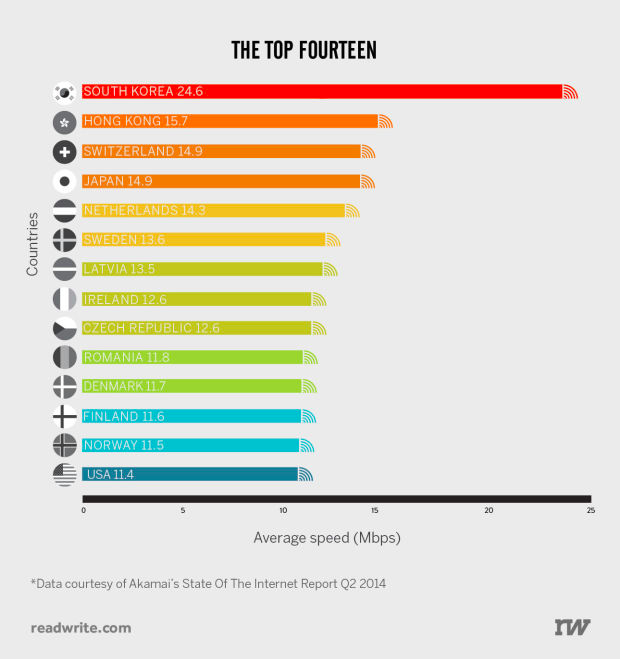
The US is #14 in the world for average internet connection speed:


 source: http://readwrite.com/2014/10/09/us-broadband-slow-overpriced-south-korea-romania


Broadband costs the most in the US:


source: http://www.bbc.com/news/magazine-24528383

In fact, the US ranks 30th out of 33 countries for the cost of 45 Mbps broadband connections.

Our internet costs us so much because consumers have little choice. Most markets are dominated by just one or two main providers.

source: http://www.huffingtonpost.com/2014/03/04/cable-company-map_n_4892435.html

And, when you look only at broadband providers, a full 75% of American households only have a choice of one provider:


source: http://www.nytimes.com/2015/02/26/technology/limited-high-speed-internet-choices-underlie-net-neutrality-rules.html?_r=0

So, to all of you out there who think the FCC is doing the wrong thing on net nutrality, let's hear your plan (I’m talking to you, Ajit Pai). How is the US going to get fast and cheap broadband to our citizens?

Monday, March 11, 2013

Simple (and Cheap!) Continuing Education For Your Team

Just published over on the Up & Running blog about how a book purchase program and book club can be simple, but powerful programs to help boost and encourage your team's education. Check it out and let me know what you think.

Thursday, December 06, 2012

Lean Planning

I just posted a piece about a new business planning methodology called Lean Planning. Lean Planning takes the best of traditional business planning and merges it with the methodologies of 'The Lean Startup' by Eric Reis. It also extends beyond optimizing the startup process to incorporate better methods for managing growing companies.

We've been working with Lean Planning principals at Palo Alto Software for a while and I'm curious to see what other people think.

Sunday, December 02, 2012

A question that every business should ask

Silicon Valley is buzzing about how the funding environment for startups is changing. Sarah Lacy has a good post on it. Fred Wilson provides his own explanation. YCombinator is even shrinking their current class size, although they are blaming it on internal problems, not the larger funding environment.

This feels similar to the crash in the early 2000s when companies with no real way to make money were funded with abandon.

Techcrunch is now reporting that when startups are getting meetings with investors,
"Investors are increasingly asking 'What’s the business model?'"
Call me old fashioned, but shouldn't every business ask themselves this question? It shouldn't take a savvy silicon valley investor to ask this. Anyone starting a business should be asking this question of themselves.

And beyond just asking how you plan on making money, it never hurts to explore a simple budget to see if the business is actually viable. I'm not talking about a 5-year forecast, but a simple model that shows the costs of acquiring and servicing a user and what that user might be willing to pay. This simple back-of-the-napkin exercise is fundamental to entrepreneurship and critical for anyone considering starting a business.

I know, some of us entrepreneurs want to change the world with our ideas. But the fact is, being an entrepreneur is about creating a business, and businesses need to make money. I don't think it gets much simpler.

Image courtesy Andrea Resmini on flickr

Wednesday, November 14, 2012

7 Keys to a Perfect Pitch

What are the 7 critical components to a perfect elevator pitch? Check out my latest post on Bplans.com to find out.

Tuesday, November 06, 2012

Why I Love Vote-by-Mail

The first election that I voted in was the 1992 presidential election.

I remember walking off campus in Princeton, NJ, to the local elementary school to cast my ballot. I was 18 and excited to participate in our great American democracy.

Stepping into the voting booth with my ballot, I was suddenly faced with not just one decision, but a multitude of options that I was not prepared for. I knew who I was voting for in the presidential race, but just wasn't familiar with everything else on the ballot.

Leaving options blank on the ballot seemed like such a waste, but I didn't want to accidentally vote for something or someone that I didn't believe in.

Frankly, this first voting experience was a bit disappointing. I was glad that I voted in the presidential election, but felt like a let myself down, not coming into the voting booth a bit more prepared. It was like showing up to take the SAT without a #2 pencil and having never seen a practice test before. I was completely un-prepared.

Having learnt my lesson the first time, I tried to be better prepared in future elections. My then girlfriend (and now wife) would study the election handbooks that came in the mail and put together "cheat sheets" to take into voting booths in New Jersey, and then California. But, this process still felt broken. Lots of preparation was required, and inevitably, we would forget to study a particular issue and not know how to vote in the few silent, private minutes behind the voting curtain.

And then we moved to Oregon in 2002 and experienced a fundamentally better way to vote. For those that don't know, Oregon citizens ALL vote by mail. There are no polling places, no lines to wait in. Your ballot is mailed to your home a few weeks before the election and you can send it in (or drop it off) anytime between when you receive it and election day.

My first experience voting in Oregon was after dinner one night at my in-laws house. We cleared the dinner table, all got out our ballots, pulled together some research material and went through, vote by vote, issue by issue.

Sitting around the table, we could discuss the issues. Debate the pros and cons of candidates, and make truly informed decisions.

There was no time pressure. No excuse for not knowing about an issue. And, most importantly, no questions left blank.

This type of voting is so far superior to anything else out there - except maybe internet voting, if that ever comes. I like being able to vote, knowing that my ballot was filled out intelligently. It's just such a better experience than entering a voting booth.

And, as an added benefit, vote-by-mail seems to improve voter participation rates. Oregon ranked in the top 5 in the 2010 midterm election.

But, regardless of how you vote or who you vote for, just get out there today and vote. As a citizen of the US, it's a privilege and a fundamental responsibility.

Monday, October 29, 2012

The difference between Apple and Microsoft

Here, in a nutshell, is the difference between Microsoft and Apple:

Apple’s products say, “You can’t do that because we think it would suck.” Microsoft’s products say, “We’ll let you try to do anything on anything if you really want to, even if it sucks.”

Quoted from Marco Arment's excellent post about Microsoft's Surface.

Thursday, July 12, 2012

Failing Gracefully

Fred Wilson's Friendly Failing blog post reminded me of one of my favorite phrases: fail gracefully. I think I first heard this term when I worked at Yahoo. Engineers and product managers would talk about what would happen when users experienced an error on a web site and they always wanted to be sure that the site would "fail gracefully."

Failing gracefully in this context means that a site shouldn't just deliver a random error message, but should explain to the user, in plain language, what had happened and what their next steps should be. These days, you see this done frequently with good 404 pages and other types of error pages on sites.

Ideally, an application will fail so gracefully that a user won't even realize that a failure has taken place. At Palo Alto Software, our site search uses a custom Nutch and Solr configuration to regularly crawl and index our sites. But, as with all things, this solution sometimes fails. In that case, the system automatically fails over to a basic Google custom search. The Google solution is still quite serviceable and works well. Most importantly, end users won't even know that our preferred solution failed and is off-line. For me, this is the best way to fail gracefully and we strive to achieve this kind of seamless failure in all of our development.

The other context for failing gracefully is when you actually lose. You lose a contract, a game, whatever. You failed to win. My high school rowing coach drilled this into me and my teammates: that no matter the situation, if you lose you take the loss gracefully, always respect the winner, and learn from the situation.  Not that we lost often (my coach was excellent), but if we did, we needed to learn as much as we could from the situation so that we could compete better the next time. When we failed, we failed gracefully and were never the sore losers who blamed a loss on others.


Tuesday, July 10, 2012

Microsoft Surface: This was my computer...8 year ago

When Microsoft introduced their Surface tablets a few weeks ago, I had a deja-vu moment. Hadn't I already seen this computer? Hadn't I used it as my primary computer for nearly two years around 2004/2005?

What I was remembering was my trusty Motion Computing tablet running Windows XP Tablet Edition. Granted, the Motion tablet was nowhere near as slick as what the Surface looks to be, but it honestly doesn't seem like Microsoft has evolved too much in the meantime, either.

I used my Motion tablet as my primary computer. Because it ran full Windows XP, I could run any applications that I needed to. I could grab the tablet and take it to meetings and take notes using One Note (which had excellent handwriting recognition, by the way). When I got back to my desk, I would drop the tablet into it's docking station and it would instantly connect to an external monitor, keyboard, mouse, etc. Although the image to the left isn't my personal setup, it did look something like that.

Although I am now a truly converted Mac guy, this setup was really very good. No hassles syncing devices. No reduced set of applications on the tablet. No missing files. I always had my full computer with me and it could be easily converted from tablet, to desktop, to laptop (with a keyboard case not un-like the Logitech Keyboard Case for iPad).

So, while the Surface looks like a pretty cool device, it doesn't feel like Microsoft has innovated very much in the past 8+ years. We're still looking at a laptop replacement that runs a complete version of Windows (with the Pro version of Surface). Granted, Windows 8 is very different than XP, but has Microsoft actually evolved all that much?

But, regardless of whether Microsoft has evolved or not evolved, the concept of a "complete" OS on a tablet is a good one. For those in the enterprise, all your applications will still work, and you'll be able to work on them in some form from both a tablet interface or from a "normal" laptop-style interface. The situation I described above was a great working environment. And, while I do work mostly in the cloud these days, I would love to be able to dock my iPad to a large monitor and keyboard/mouse and have a solid desktop computing environment that could easily convert to tablet format at a moment's notice.

Some are raising the question of whether Microsoft will have an "app" ecosystem to rival the Apple app store. I believe this is almost a non issue in the short term. There is tons of Windows software still out there and there is plenty of custom software in the enterprise that will ONLY run on Windows computers or in Internet Explorer. Hard to believe, but true.

Most Windows developers will only have to do a little work to make their software work for Windows 8. Many won't have to do any work at all. Microsoft has an app ecosystem that they've been developing for over 2 decades and it's not quite dead...yet.

And, by the way, isn't it ironic that we are now talking about the availability of software for a Microsoft product? That the major problem with choosing a Mac for over a decade... not enough software. Now, it looks like the shoe is on the other foot. Funny how the world changes.

I'm looking forward to see how the Surface does in the market. I think it has a decent chance at stealing market share from traditional Windows laptop makers. Will it steal from the iPad? I don't think so. Surface will succeed in the enterprise, though.

Thursday, July 05, 2012

Writing a one-page business plan

If you're like most people, writing a business plan is something that frequently gets pushed to the bottom of your to-do list. After all, who wants to write a 30-60 page paper?

Well, gone are the days of the long, draw-out business plan that does nothing more than site in a drawer. My latest blog post over on the Bplans.com Up & Running Blog details how to get a business plan done in one page.

Check it out and let me know what you think.

Friday, April 20, 2012

Including assumptions in your business plan

I just published a new post over at the Bplans.com Up & Running blog about including assumptions in business plans. Every business plan should document the core assumptions that drive the business and include a test plan for validating those assumptions. Not only will this make your business plan actionable but it will help guide you towards a successful business.

Read the full post here.

Thursday, January 13, 2011

Do you deliver what you promise?

Seth Godin had a great post today about setting expectations in your marketing. He discusses the all-to-common fact that big companies advertise great customer experiences but rarely deliver. Under-delivering on a promise leads to customer disappointment. So, the choice is to either not promise anything and hope that you meet expectations OR promise something that you can deliver.

As serendipity would have it, I happened to have an interaction with Zappos.com customer service today. I’ve heard for years about Zappos’ legendary customer service, but, awash in advertising that promises great customer service and companies that rarely deliver, I certainly had my doubts. Could a company that processes billions of dollars of sales a year really provide great customer service? It turns out that they can. I was not only surprised, but totally blown away by the quality of service.

The fact is, most customers these days expect to be disappointed. They look at advertising that promises a great experience and instead of being inspired to try a new brand, question how it could possibly be true. Many customers, like me, doubt that any company will actually live up to (let alone exceed) their marketing.

Therefor, it does not take much to wow your customers. Even doing things as simple as showing up on time, returning calls promptly, keeping your job site clean, delivering more than was expected for your consulting contract, etc. - these are all enough to WOW your customer and generate loyalty. It’s these little things that keep customers coming back time and time again.

I see this every day here at Palo Alto Software. We’ve done away with our phone tree. Most customers can talk to a customer service agent with less than 1 minute of hold time. We let people download their software years after they purchased it - for free. It’s the little things that count and because customer service is so often bad, it’s easy to please.

Back to Seth’s post. His final word of advice is to invest the money you would have spent on advertising into actual customer satisfaction. Since great customer experiences are few and far between, a happy customer is bound to be a loyal one. And not just a loyal customer, but one that tells 10 of their friends to also use your services.

Tuesday, January 04, 2011

Is your brand a luxury brand?

As little as a 5-6 years ago, computers and cell phones were purely utilitarian devices. That is, they were used to get tasks done. They weren't always very pretty to look at and certainly not things that you necessarily craved - unless your inner geek needed whatever was the latest and greatest technology. "Sexy" was certainly not a word ever used to describe the latest Dell, Motorola phone, or the newest desktop from HP.

Then Apple managed to change the world. Most people think that Apple's great innovation was the invention of the portable mp3 player.  Far from it. Plenty of others existed when the iPod  came along. What Apple focused on was design - the design of the software that ran on the iPod, the industrial design of the actual device,  and the simplicity of a single ecosystem for managing your music and getting it onto your device.

Even at the time the iPod first launched, it did less than it's competitors. It had fewer features yet it was more expensive than almost anything else out there. Even today, the current crop of iPods still does much less in raw functionality than alternative players. And yet, they still cost more.

What Apple knew was that customers craved simplicity and would be willing to pay for a device that looked cool. People could show off the fact that they owned an iPod with the (now ubiquitous) white headphones even when the device was in their pocket. If it cost a little bit more, that would make it slightly exclusive as it would scare away the bargain hunters and the pure feature geeks.

Apple created an accessible luxury. Something that cost a little more, something that customers craved. This started  mostly in the form of iPods, but now comes  in the form of subsidized iPhones and is extending to the iPad (although the iPad is priced to be a little more exclusive and not as affordable to the general populace).

Apple's computers are truly heading into "luxury" territory. The least expensive MacBook is $1,000, yet I can go down to my local "big-box" store and get a reasonable laptop for $300. I know - these two computers can't be compared in terms of quality, bundled software, processor speed, etc. I'm simply pointing out that the price of admission into the cult-of-mac is quite a bit higher than the cost of entry into the general world of laptop computing. When you open up your MacBook in the local Starbucks, everyone knows that your computer is a "premium" computer and not just some run-of-the-mill Dell.

Which brings me to my real point: What's so great about being a luxury brand?

First of all, you're protected from feature or performance competition. To compete, you need better style, perhaps better quality, and certainly better customer service. The experience of purchasing a luxury brand needs to be top quality from your initial shopping experience to customer support, but you don't necessarily need to compete on core features. Often times, less is actually more.

Second, you don't have to compete on price so your margins can be big.  In fact, you better have a premium price to substantiate your premium brand. Not only do you have a premium price, but you need to make sure that your products aren't offered in discount locations that can't support your entire brand experience. What this generally means is that you get to command higher margins than your competition and hopefully reap the profits at the end of the day. Luxury products tend to be highly profitable.

Third, your market is slightly more affluent than the target markets of other brands. Your customer is able to spend a little more to get a product that they can show off. This segment of the market is a little more resilient to economic ups and downs and will be able to spend money with you even when the economy tightens up.

Here's where Apple has had a brilliant strategy: not everyone can afford their higher-end computers, but they have plenty of "affordable luxury" products so that you can get a piece of the brand without having to pay thousands of dollars. This is equivalent to Coach selling slightly less expensive handbags or Dolce & Gabbana selling sunglasses for around  $100. Customers get to get a taste of a luxury brand at a reasonable price. Everyone likes to spoil themselves now and again with a little luxury and affordable luxuries can have great appeal. Witness the explosion of cupcake shops that sell the tiny cakes for $3 and up at huge profits!

The one potential issue with being a luxury brand is that you might have to give up the low end of the market in order to succeed. Back again to Apple, it appears that they might do this with both the iPad and the iPhone as Android phones and tablets  take over in terms of sheer volume. My guess is that Apple will stick with their high-end, luxury strategy and let the rest of the market be owned by someone else. They'll stick to their high-margin products for the top end of the market and let others fight it out to claim the rest of the market with low margins and tough price competition.

So, how can you make your own brand a luxury brand? Can you update the experience of shopping in your store or on your website? How do you make your product or service worth paying a little extra for?

Here are a few tips:

1. Extraordinary customer service. Make doing business with you a better experience than anywhere else.

2. Extraordinary product quality. Your product doesn't need to do more than the next guy's. It just needs to do the basics better.

3. Exclusivity. An endless supply of your product usually means that anyone can get it. You need to figure out a way to make your product or your service slightly scarce. Make it worth lining up for.

Is your brand a luxury brand? Can it be one?
Friday, March 20, 2009

How to compete with Wal-Mart

WSJ's Independant Street blog has an interesting post today about what small businesses can do to survive when Wal-Mart comes to town. The data shows that if businesses try to compete on price, they loose.  Small biz just can't beat Wal-Mart at the game that they own and have perfected over the decades.

What small business CAN do is differentiate:
  1. Better service. Who gets great service at Wal-Mart, Home Depot, Best Buy or any other big box store? Small businesses can differentiate by providing exceptional customer service. By doing this, prices can be kept high and possibly even be raised. Better service will also drive customer loyalty and referred business.

  2. Unique products. Wal-Mart and other big box stores only cary mainstream products. Local stores can differentiate by providing products that will never be available at the big box stores.

  3. Focus. Wal-Mart excels at providing something for everyone. What they don't excel at is deep focus in single product categories. Small businesses should look to find a specific niche and become experts at servicing that niche. In this case, less is more - a very different strategy than Wal-Mart's "more is more" strategy.
I'm sure there are plenty of other ways to compete against Wal-Mart. What are yours?

Thursday, February 12, 2009

Where are Borders and B&N in the ebook game?

I have to admit, I'm drooling over the new Kindle from Amazon. I wasn't that interested in the first version, but this second edition looks like it has fixed a lot of the issues. I still wish it had backlighting, though. Having to clip on a normal book light to read at night seems a little kludgy.

That's why I'm very excited about the forthcoming ebook reader for the iPhone from Shortcovers. I know there are other ebook readers for the iphone out there, but this will be one of the first ones connected to a large library of ebooks for purchase. In fact, you can even buy one chapter at a time in a "pay as you read" model.

But, my real question in all of this is why are Borders and Barnes & Noble not in this market? They ceeded the online book sales market to Amazon in the 90s. Now they're going to miss the boat on digital distribution as well. Amazon knows full well (and I believe this too) that physical books are going to be sold less and less over the next decade. E-ink and flexible displays are going to make book and newspaper reading an entirely digital experience. It's really just a matter of time.

So, if Borders and Barnes & Noble want to survive, they should be working with their publishing contacts (the same ones Amazon has) to build a digital book marketplace. They should hire some iPhone developers and put together a great ebook reader application. If they don't, they will become dinasours and miss this market completely. They don't need to go the hardware route as Amazon has done. Afterall, that is expensive and time consuming. Instead, they should work with the hardware platforms that are in millions of pockets already - iphones, blackberries, etc.

As I write this, I think about Tim's post today about Netflix and how much guts (and smarts) it takes to work on a new busienss model that destroys your old one. This is what Borders and B&N need to do to survive.

Wednesday, February 04, 2009

Design Patterns

User interface design has always been one of my passions and I enjoy checking out new design resources as I stumble accross them.

Today, Cale pointed me towards Quince, a "UX Patterns Explorer." This very cool Silverlight application allows you to search through design solutions to data sorting and navigation. While not every solution is perfect, it's a great resource to explore options as you are developing your own web sites and applications.

Friday, January 30, 2009

92% of Americans Employed

I'm usually a glass-half-empty kind of person. I can't help it, but I'm generally a pessimist.

But, right now I'm a firm believer that one of the only ways we as Americans can help lead ourselves out of our financial crisis is to be optimists. As Aaron Patzer points out in his guest post on TechCrunch today, Americans (who use Mint.com) are spending an average of $400/month less. Of course, layoffs aren't helping. But, the fact remains that 92% of Americans have their jobs still. Many of these people haven't even taken any pay cuts. They are just spending less - maybe out of fear of what's to come, acknowledgment that they should have been saving more in the past, or just from a lack of optimism.

I'm not an economist (far from it) but it seems pretty clear that the country could start turning itself around if the 92% of employed Americans simply started spending again - maybe not all of the $400/month they aren't spending now, but how about half of that. Of course, in the long term Americans need to have better savings habits, but now is not the time to go that route. We need money flowing through our economy and getting average Americans to spend is one of the best ways to do that.

In fact, Finland is on the cutting edge of this scenario. They are running a national ad campaign that encourages people to start spending. Read more about that story at NPR.org.

Free webinar on simple marketing tactics

John Jantsch of Duct Tape Marketing fame will be giving a free webinar on Simple Marketing Tactics on February 11, 2009 at 12:00pm CST.

"Let's get back to basics and start utilizing simple, effective and affordable marketing tactics to create momentum that carries your business through the tough times and allows it soar in the good times."

Reserve your spot today!

Thursday, January 29, 2009

Fail Gracefully

Tim Berry's blog post today on "failing forward" reminded me of one of my favorite engineering/application design phrases: fail gracefully.

What does this mean? It means that you should design your applications and web sites to provide the end user with useful and informative information when it runs into a problem. Failing gracefully means:
  • Providing useful 404 pages on your web site
  • Not displaying only error codes when your application crashes. Provide information that will help the user fix the problem.
  • Not letting engineers write your error messages. (see point 2)
  • Making sure errors behind the scenes don't bring everything else to a screeching halt
Beyond writing code and developing applications, the "fail gracefully"concept is useful in business. This means:
  • Having good backup plans if things don't go as you originally planned.
  • Knowing what your alternatives are.
  • Planning ahead for optimistic and pessimistic scenarios
  • Learning from your mistakes
Not that any of us ever want to fail, but it's inevitable in business, entrepreneurship and life. So, failing gracefully is a much better option than just failing.

Friday, October 10, 2008

Good business reading coming soon


I'm looking forward to two (most likely good) books from my favorite business authors that are coming out later this month:

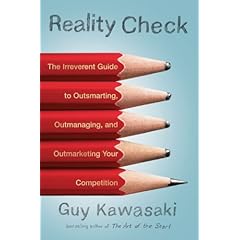
Seth Godin's Tribes and Guy Kawasaki's Reality Check both come out in a few weeks and I'm sure they will quickly become required reading for entrepreneurs and marketers everywhere.

For a long time, I've admired both of these authors for their ability to cut through the BS and provide business advice that you can apply to your business immediately. There's no academic, theoretical garbage to muck up the messages. You come away from reading anything by these authors thinking, "I already knew what they told me, but they presented it in a much better way than I ever thought of."

Anyway, pre-order these books on Amazon. I'm sure you won't be disappointed.